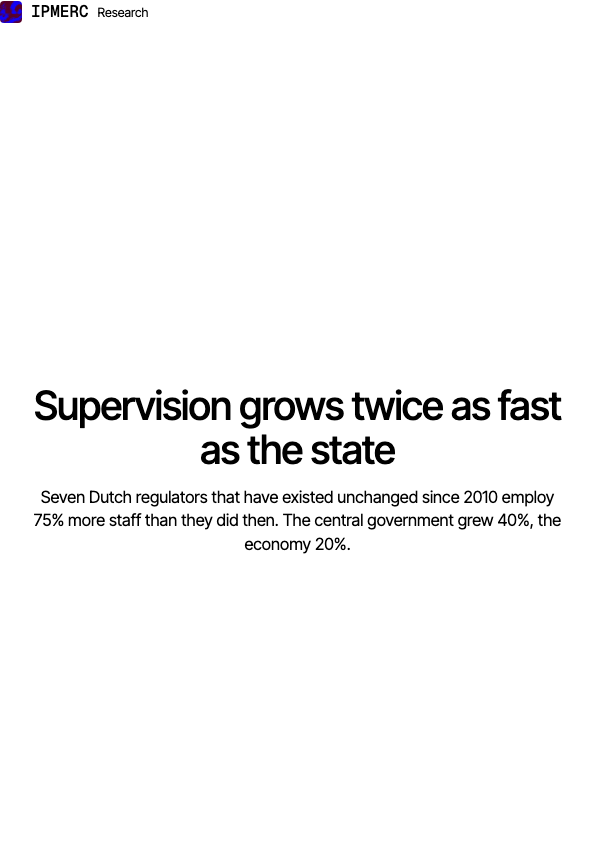
Seven Dutch regulators that have kept the same form since 2010 grew from 2,730 to 4,772 full-time staff, a rise of 75%. The data protection authority went from 79 to 312, the mines inspectorate from 57 to 188, the healthcare authority from 254 to 521. The financial markets regulator AFM grew 70% and the central bank DNB 54%. The central government as a whole employed 160,016 full-time staff at the end of 2025 against 114,328 at the end of 2010, up 40.0%. The whole Dutch economy grew 19.6% in full-time years over the same period. Inside the central government, inspection work grew 33.5% between 2021 and 2025, against 22.0% for all staff. The growth tracks new legal duties: the GDPR in 2018, online gambling in 2021, the Groningen earthquakes, and new European financial rules. The Jetten cabinet books €1.4bn of savings on the government apparatus in 2030. The CPB, the government's own forecaster, counts €0.2bn of it and calls the rest implausible while no tasks are dropped. Growth already stalled in 2025: the competition authority shrank, the health inspectorate shrank, the healthcare authority stood still, and the central government added 1.9%.