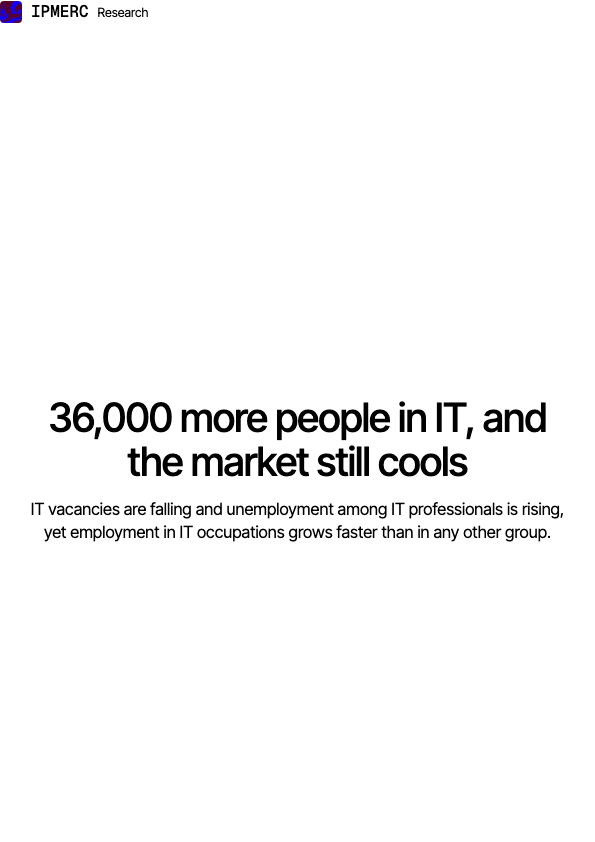
The Dutch IT labour market has been cooling since 2023. Yet employment in IT occupations grew by 36,000 year on year in the second quarter of 2026, the largest increase of any occupational group. Those figures do not contradict each other: the market is normalising after an exceptional peak, but the constraint has moved from volume to fit. In 2024, 63% of companies that tried to recruit IT staff failed to fill every vacancy.
ICT
3 papers
The ICT labour market: specialists employed, firms that cannot fill an ICT post, the reasons they give, and the cloud dependency behind the demand.
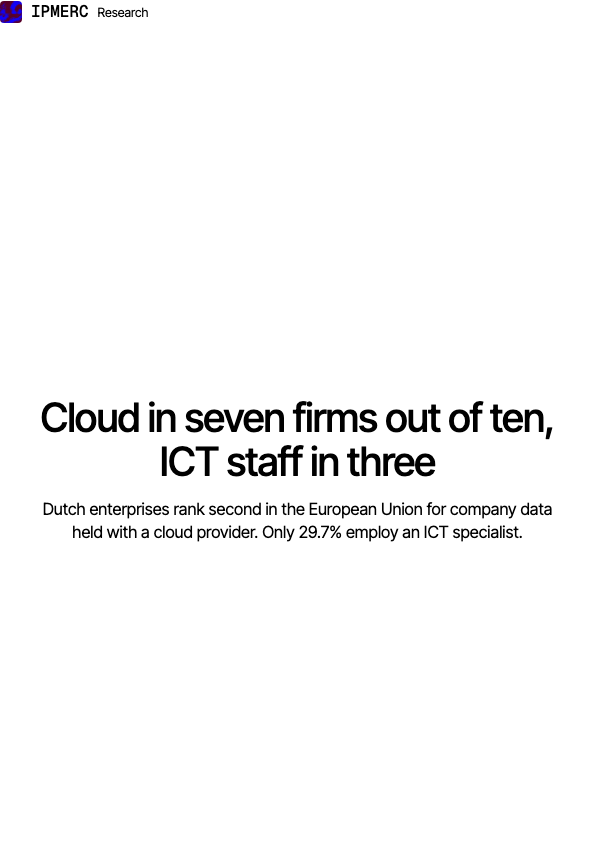
In 2024, 71.0% of Dutch enterprises with 10 or more employees bought paid cloud services. In the same year 29.7% of them employed an ICT specialist. By 2025, 55.4% of Dutch enterprises hosted a database or their files with a cloud provider against 24.0% across the European Union, and only Denmark was higher at 55.5%. Migration off those services requires ICT staff. Of the Dutch enterprises that tried to recruit an ICT specialist in 2024, 63.1% were left with a vacancy they could not fill, and the reason cited most often was that nobody applied. When the Netherlands Authority for Consumers and Markets surveyed 420 business cloud users, 172 had at some point tried to switch provider. For 52 of them the attempt failed, which is 30.2% of all attempts. Among those that did switch, 52.5% used an intermediary.
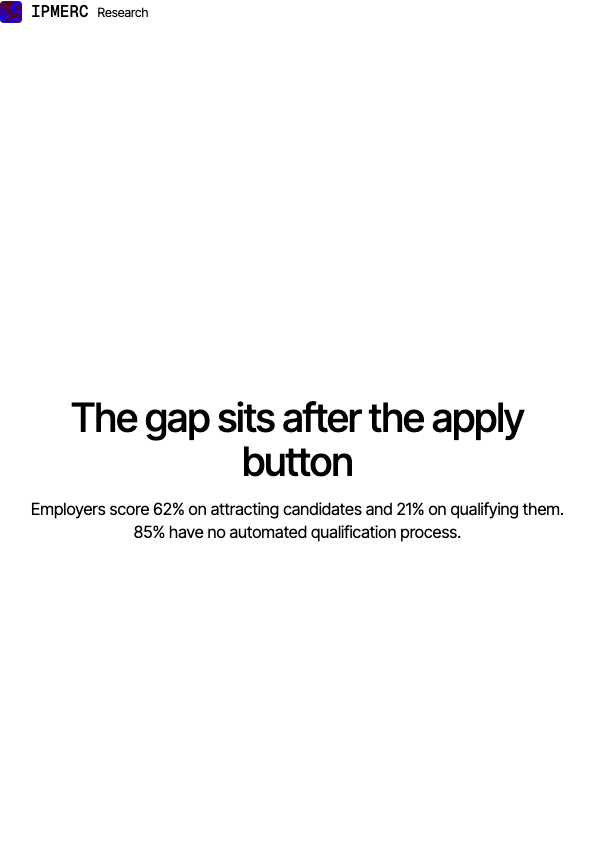
In 2026, platform vendor Phenom audited 219 employers across eight industries on the automation of their hiring process. On attracting, engaging, and converting candidates, employers average 62% of the attainable maximum. On qualification after the apply click, the same employers average 21%, a gap of 41 percentage points. 94% do not schedule an interview at the point of application. 99% do not use video interviews inline. Less than 1% have a fully orchestrated qualification process. For frontline roles, 85% sit in the lowest automation tier. For knowledge worker roles the figure is 93%. No industry scores above 30%. The data comes from a platform vendor measuring against its own product categories, and that caveat applies to every use of the figures.