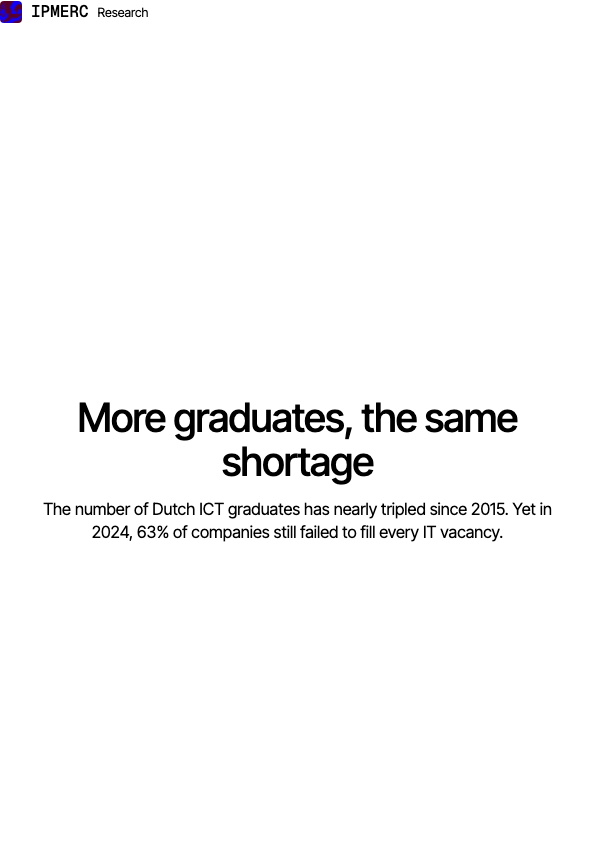
The Netherlands produced 8,710 ICT graduates at bachelor and master level in 2024, against 3,101 in 2015. That is a rise of 181% in nine years, far faster than the 28% growth in total graduates. Yet the share of companies with hard-to-fill IT vacancies stayed around 63%. More supply from education has not resolved the shortage, and this report sets out why.
Education
3 papers
The supply side of every shortage: graduates, training, and the young people who are neither in work nor in education.
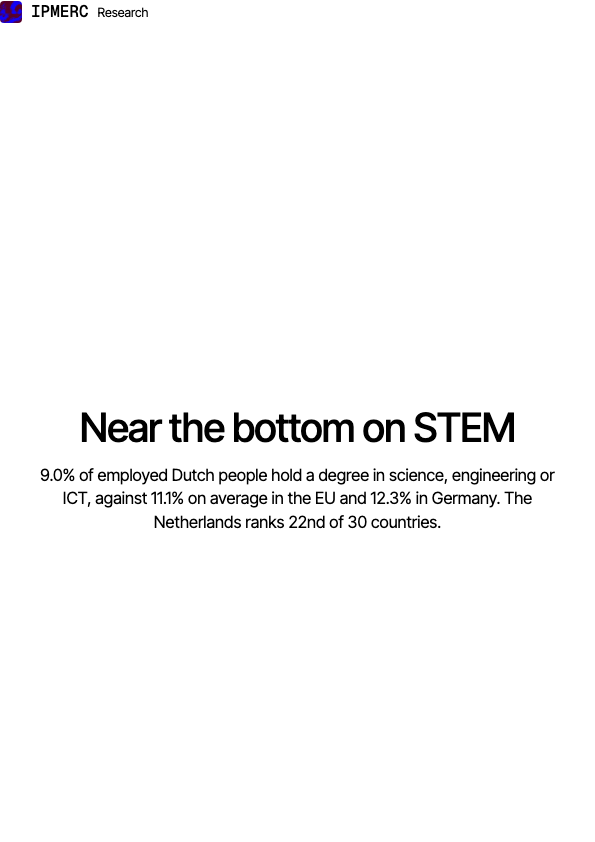
The Dutch economy runs on technology, but its working population is thinly educated in it. In 2025, 9.0% of employed people held a completed tertiary degree in the STEM fields of science, engineering or ICT, against 11.1% on average in the EU. That puts the Netherlands 22nd of the 30 measured countries; Lithuania leads with 15.1%. The stock is growing, from 748,700 workers in 2021 to 869,500 in 2025, a rise of 16%. Of them, 65% work as professionals and some 12% outside the knowledge occupations.
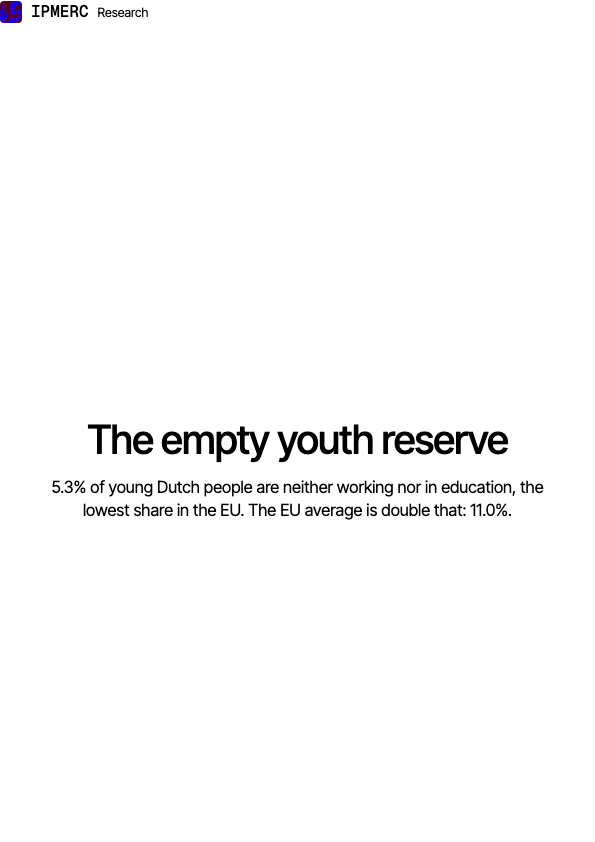
Every plan that counts on activating young people runs, in the Netherlands, into an empty reserve. Of people aged 15 to 29, 5.3% were neither in work nor in education or training in 2025, the lowest share in the EU; the average is 11.0% and Sweden follows at 5.9%. Within that small group, most are willing: 4.3 of the 5.3 percentage points say they want to work. The reserve is not unwilling but thin, and whoever recruits from it competes with all of Europe for the continent's smallest surplus.